Visuals
The site
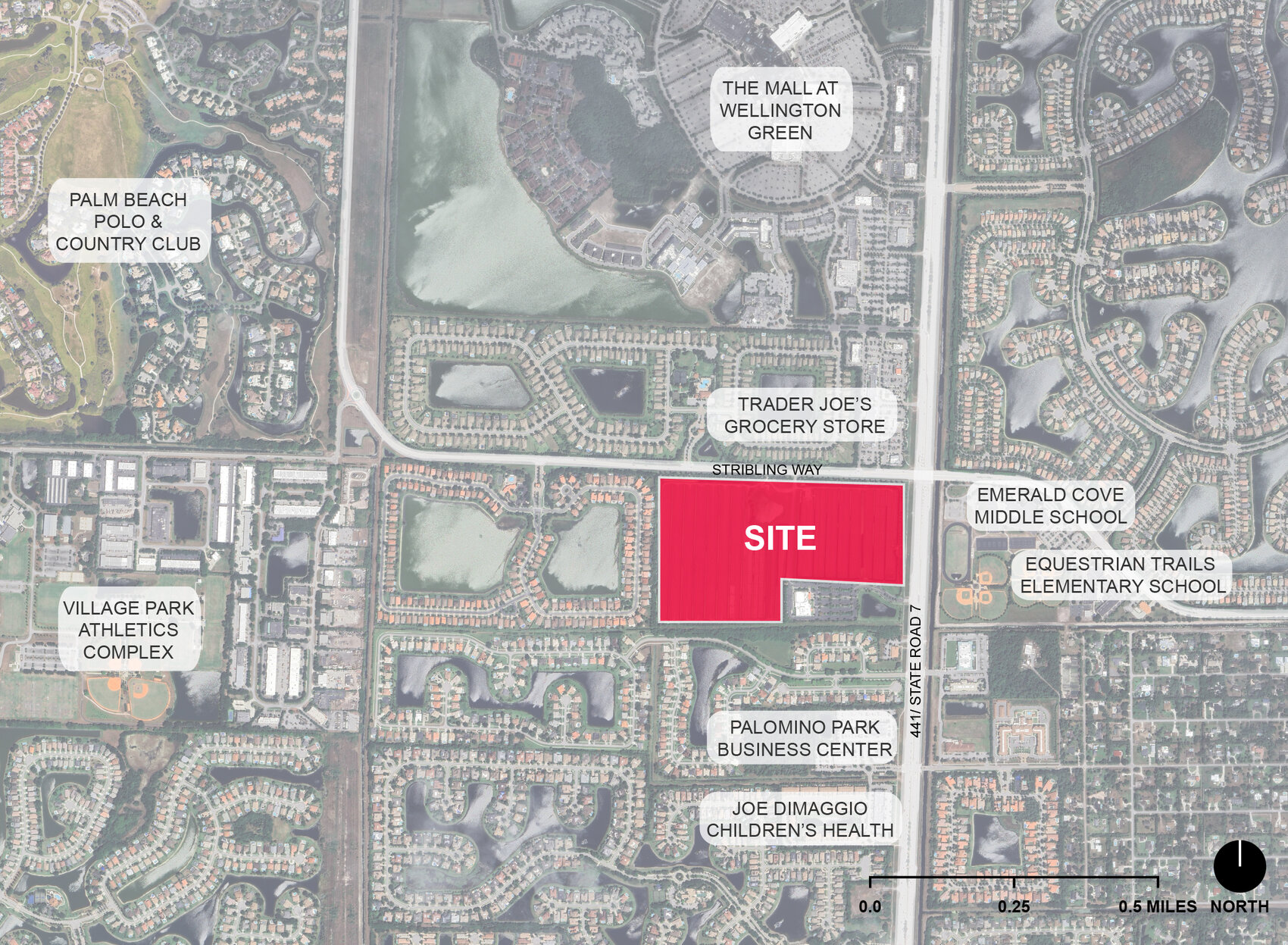
A ~70-acre, ~$650 million mixed-use community on Stribling Way — homes, retail, a 150-key hotel, and a PK-12 private school — measured for the jobs, output, and tax base it delivers to the Village of Wellington.
Wellington Village is a mixed-use development on roughly 70 acres at 10400 Stribling Way in the Village of Wellington, Florida. The program integrates 562 residential units — including 85 workforce-housing units — with 131,000 square feet of retail, dining, and services, a 150-key hotel, and a 240,000-square-foot PK-12 private school designed for 1,600 students, forming a self-sustaining community rather than a single-use parcel.
The Related Group engaged BusinessFlare® to quantify what that vision means in dollars, jobs, and public revenue. Using Input-Output methodology (Lightcast/Emsi Type II) and property-appraiser-based fiscal projections, the assessment separates one-time construction impacts from recurring annual operations, and translates the project's ~$650 million of investment into a defensible picture of economic activity and tax base for the Village and its other taxing authorities.
At full build-out the project represents an investment of nearly $650 million. Construction alone is projected to support up to 3,699 jobs, more than $341 million in earnings, and $834 million in economic output — and once stabilized, the community sustains roughly 997 ongoing jobs and about $140 million in annual economic output, while lifting the site's taxable value to approximately $495 million and generating an estimated $1.4 billion in ad valorem receipts for all taxing authorities over 50 years.
Four lenses on Wellington Village — the proposed development, its economic impact, its fiscal contribution, and the community benefits it unlocks.
Wellington Village blends residential, commercial, hospitality, and education uses into a single walkable district — a self-sustaining neighborhood rather than a single-purpose parcel, replacing land otherwise classified for agricultural use.
The economic analysis models direct, indirect, and induced impacts during construction (one-time) and after completion (recurring), using BEA and BLS QCEW source data and Type II Input-Output multipliers to capture supply-chain and household-spending ripple effects.
Reassessed after completion, the property's taxable value rises to roughly $495 million by 2029, driving property-tax revenue far above what the land would yield if it stayed agricultural — where 50 years of Village taxes would total just ~$33,000.
Beyond the numbers, the project expands housing choice and affordability, adds quality education capacity, and creates broad occupational opportunity — supporting Wellington's economic-development goals and long-term quality of life.